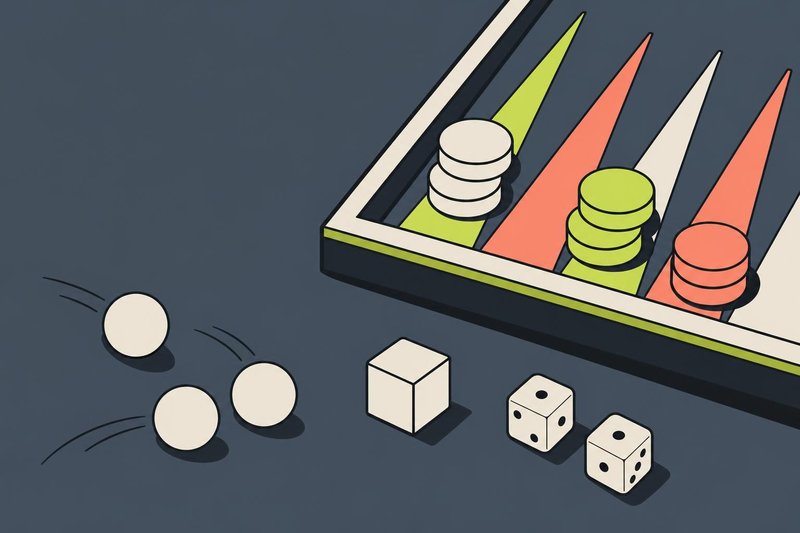
A money game of backgammon played for $10 a point can end with the doubling cube on 8 and the loser caught with a checker still in the winner’s home board. That is a backgammon, worth three times the cube, and it costs $240. Nobody started the game expecting to play for that much. Backgammon gambling works this way because of one small die with no pips, and most of what is worth knowing about the game for money comes back to it.
This guide covers the rules, the cube, the difference between money and match play, and how computer programs changed what strong play looks like. The second part turns to bingo, the other game on this page where the players, not the house, provide most of the action.
The rules in brief: a guide for the first game
Two players each have 15 checkers on a board of 24 narrow triangles called points, and move in opposite directions toward their own home board. Each turn starts with a roll of two dice, and each number is played as a separate move. A double is played four times. To decide who starts, each player rolls a single die, and the higher number moves first using both dice.
A point holding two or more of a player’s checkers is blocked to the opponent. A lone checker, called a blot, can be hit and sent to the bar in the middle of the board, and it must re-enter in the opponent’s home board before its owner can move anything else. Once all 15 checkers are home, a player starts bearing them off. The first to remove all 15 wins.
How much a win is worth depends on how far behind the loser is. A loser who has borne off at least one checker loses a single game. One who has borne off none loses a gammon, worth double. And one who has borne off none while still having a checker on the bar or in the winner’s home board loses a backgammon, worth triple.
Backgammon gambling and the doubling cube
The cube starts in the middle at 1, its faces marked 2, 4, 8, 16, 32 and 64. Before rolling, either player may offer to double the stakes. The opponent either takes, so the game continues at twice the value with the taker now holding the cube and the sole right to redouble, or drops, conceding the game at its current value.
The arithmetic behind a take is simple. Dropping a one-point game costs one point. Taking risks two points to win two, which breaks even at a 25% chance of winning. In practice the line moves a little: owning the cube after a take has value of its own, which lowers the threshold, while gammon chances push it back up.
The cube is younger than most people assume. The board game is thousands of years old, but doubling arrived in the clubs of New York in the 1920s, where players looking for a faster, sharper game for money hit on the idea of letting either side raise the stakes mid-game. No single inventor is agreed. Within a decade doubling was standard, and it turned a slow race into a game of judgement about when to push and when to let go. Modern backgammon gambling, in clubs and online, has been built on it ever since.
Money play, match play and the best use of the cube
The cube plays differently depending on what is being counted.
In money play every point is settled in cash, and each game stands alone. Most private backgammon gambling, from club chouettes to a board on a café table, is played this way. Two house rules are common. The Jacoby rule, named after the bridge and backgammon writer Oswald Jacoby, says a gammon or backgammon only counts once the cube has been turned. Some games also allow beavers, where a player who is doubled can immediately redouble while keeping the cube. Both should be agreed before the first roll.
In match play the aim is to reach a set number of points first, typically somewhere between 5 and 25 depending on the event. The score changes everything. A take that is clearly right at the start of a match can be a blunder when one player is close to winning, and strong players carry match equity tables in their heads to judge it. The Crawford rule, named after John R. Crawford, switches the cube off for one game when a player first gets within a point of the match.
The best cube decisions are usually the boring ones. Doubling too early gives away value; doubling too late lets the opponent drop a position they would have lost. Most club players err in one direction consistently, which is why a review of your own matches is the quickest way to find the leak.
Skill, dice and the bots
Over a single game, a lucky roll can beat anyone. Over a long match the stronger player wins more often, and over hundreds of games the difference becomes clear. That puts backgammon closer to poker than to anything in a casino pit: luck decides the evening, skill decides the year.
Computers sharpened the picture. In 1992 Gerald Tesauro at IBM built TD-Gammon, a neural network that learned by playing itself rather than by studying human games. It played near the level of the best humans and preferred some opening moves that experts had dismissed, and the experts changed their play. Commercial programs followed, among them JellyFish and Snowie, then the free GNU Backgammon and, in 2009, eXtreme Gammon by Xavier Dufaure de Citres. Today almost every serious player runs matches through a bot afterwards and measures their errors against it. A bot is a better guide to the opening than any book, and the most reliable backgammon info now comes with its analysis attached.
Much older backgammon info, written before the bots, is still pleasant reading and still useful on general ideas, though its opening advice has aged. The resources page collects further reading across all the games.
Tournament play is organised at national and international level. In the United States the U.S. Backgammon Federation, founded in 2009, has run the American Backgammon Tour since 2017. The World Backgammon Federation brings national bodies together, and the World Championship has been held in Monte Carlo every summer since 1979, with the exception of 2020.
What to look for in online backgammon sites
Online play began on 19 July 1992, when the First Internet Backgammon Server started taking connections and gave players an Elo-style rating that began at 1500. Rating systems built on the same idea are still the first thing to check on online backgammon sites. A published formula, with ratings that respond to match length, means the number next to an opponent’s name says something real.
Licensing comes next, because real-money backgammon gambling online is a regulated activity in Britain and many other markets. In Britain the Gambling Act 2005 treats a game that combines skill and chance as a game of chance, so a site offering real-money backgammon to British players needs a Gambling Commission licence. Elsewhere the rules vary, and online backgammon sites licensed in one country may not be allowed to serve players in another.
Then the price. A real-money online game has to be paid for somehow, usually by a share of each point won in money games or a fee on top of a tournament entry. Compare that figure as carefully as a poker player compares rake. The best online sites also explain how their dice are generated and tested, how they deal with players who consult a bot during a game, and whether matches can be exported for review in a program such as GNU Backgammon.
Bingo: 75 balls, 90 balls and the hall’s share
Bingo comes in two main forms. The North American game uses 75 balls and a five-by-five card under the letters B-I-N-G-O, with 24 numbers and a free square in the centre; prizes are paid for lines and set patterns. The British game uses 90 balls and a ticket of three rows and nine columns, with 15 numbers on each ticket and five on each row. A strip of six tickets covers every number from 1 to 90 once, and prizes go to the first player to complete a line, then two lines, then a full house.
The players fund the prizes. Most of the money staked on a game goes back out as prize money, and the hall earns its share through participation fees or admission, plus food, drink and gaming machines. Linked games played across many clubs at once pool the stakes into larger prizes, the same principle that drives lotteries.
In Britain bingo clubs need an operating licence from the Gambling Commission and a premises licence from the local council under the Gambling Act 2005. From 1 April 2026 the government abolished bingo duty, the 10% tax on bingo profits, a change the government said would help around 250 clubs. Outside tribal land, bingo in the US is mostly charitable gaming licensed by the states, and bingo on tribal land counts as Class II gaming under the Indian Gaming Regulatory Act of 1988.
Some things have not changed in a century of halls. A caller in a British club still announces 22 as “two little ducks” and 88 as “two fat ladies”, and nobody in the room needs either explained.